
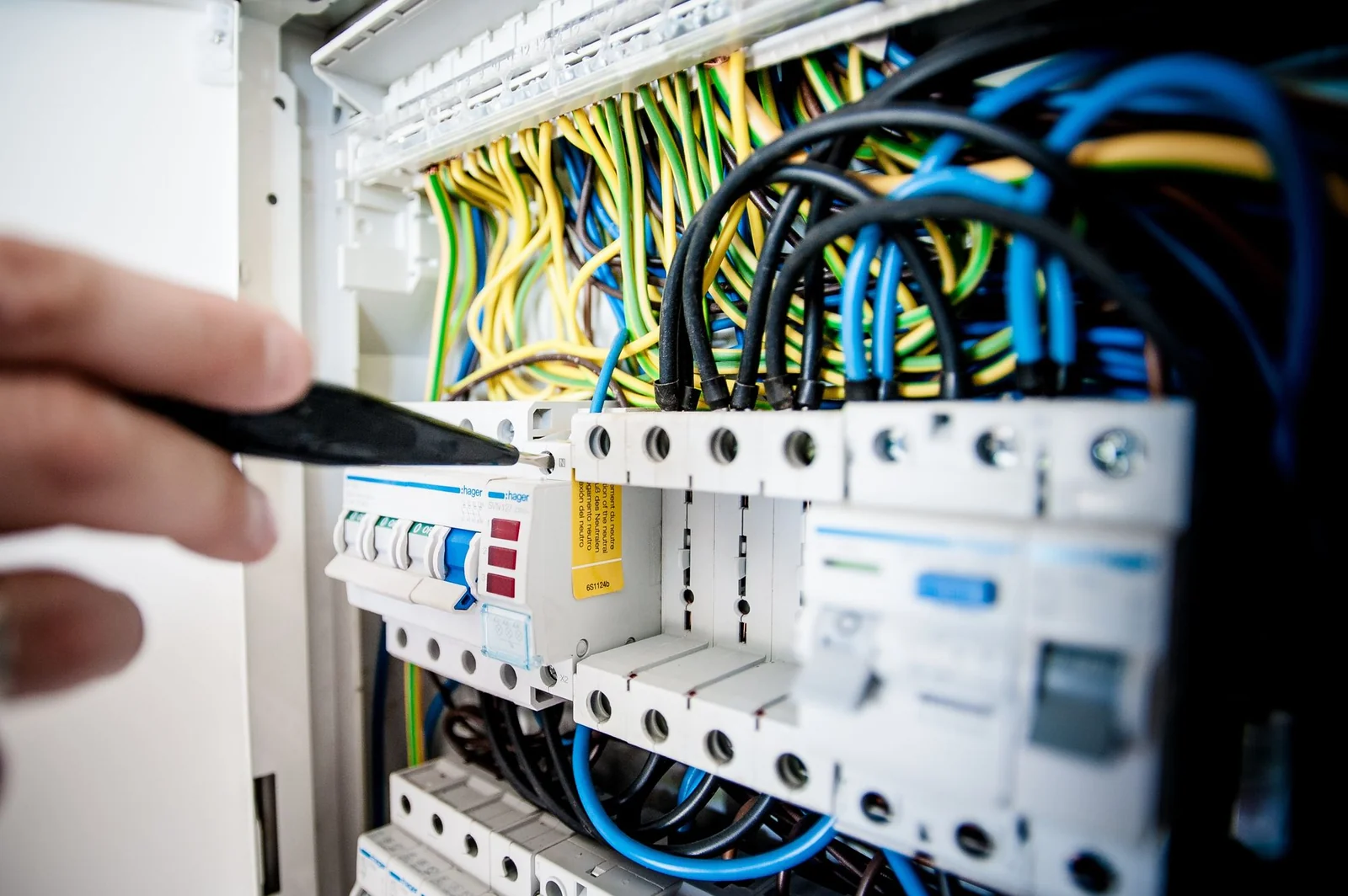
A home electric sauna heater is a fixed appliance on its own circuit. The maker’s nameplate and your local electrical code set the rules. A licensed electrician reads both.
This guide reproduces wiring tables only for named heater models from manuals we opened. It is not general sizing advice. We have not built or tested a sauna.
For the overview, see our guide to planning and building a home sauna.
The short answer
- Start with the heater nameplate and the installation manual for that exact model.
- The circuit is sized by your electrician to the heater’s nameplate rating and your local code.
- GFCI rules differ by brand. Quote the manual for your model, then check the inspector.
- Do not treat a retailer chart or a blog as an electrical rule.
What does the nameplate tell you?
Every listed heater carries a nameplate with voltage, phase, and current or power. That label is the starting point for the electrician. Harvia’s US KIP manual says wiring must be done by a licensed electrician who follows the diagram and local codes.
HUUM’s DROP US manual says only a certified electrician may connect the heater to the power supply. Tylo’s Sense Pure/Elite USA guide says fuse and cable size must suit the heater. See its Connection/wiring section.
We do not publish a general breaker size or wire gauge for “any” sauna. Below are three maker tables for named models only.
Harvia KIP-B1 (240 V): maker table
This table is from Harvia’s Owner’s/Operator’s Manual for the KIP series. It is PDF page 5 of the US manual we opened. It applies to the built-in-control B1 models listed, not to every Harvia heater.
| Model | kW | Amps | Voltage | Phase | Wire size |
|---|---|---|---|---|---|
| KIP-30-B1 | 3.0 | 12.5 | 240 | 1 | #12/2 |
| KIP-45-B1 | 4.5 | 18.8 | 240 | 1 | #10/2 |
| KIP-60-B1 | 6.0 | 25.0 | 240 | 1 | #10/2 |
| KIP-80-B1 | 8.0 | 33.3 | 240 | 1 | #8/2 |
These are the manufacturer’s current draw and conductor sizes, not breaker sizes. The two are not the same number. Your electrician sizes the overcurrent device to the nameplate and the code in force where you live.
The same manual (PDF page 3) requires copper wire suitable for 194°F (90°C) within sauna walls. It also requires proper grounding per NEC and local codes. Your electrician still sizes the overcurrent device to the nameplate and the code that applies on site.
Tylo Sense Pure/Elite (240 V): maker table
This table is from Tylo’s Sense Pure/Elite USA Installation / User Guide (doc 2900 5280). It is the Connection/wiring diagram on page 8. It applies to the Sense Pure/Elite models listed, not to every Tylo heater.
| Model | Amps (240 V) | Output (kW) | Wire size (AWG) |
|---|---|---|---|
| Sense U5 Pure/Elite | 21 | 5 | 10 |
| Sense U6 Pure/Elite | 25 | 6 | 10 |
| Sense U7 Pure/Elite | 30 | 7.0 | 8 |
| Sense U8 Pure/Elite | 35 | 8.3 | 8 |
These are the manufacturer’s current draw and conductor sizes, not breaker sizes. The two are not the same number. Your electrician sizes the overcurrent device to the nameplate and the code in force where you live.
Tylo also shows 208 V figures for U7 and U8 on the same page. The guide says fuse size and power cable size must be suitable for the heater. Use only the row that matches your exact model and supply voltage.
HUUM DROP (240 V): maker table
This table is Table 2 from HUUM’s DROP Installation and operation manual, US PRINT H1001L08 v8 (2026). It applies to DROP 4, 6, 7, and 9 at 240 V. It is not a chart for other HUUM heaters.
| Model | Output (kW) | Amps | Circuit breaker (A) | Min. wire (AWG) |
|---|---|---|---|---|
| DROP 4 | 4.5 | 18.75 | 30 | 10 |
| DROP 6 | 6 | 25 | 30 | 10 |
| DROP 7 | 7.5 | 31.25 | 40 | 8 |
| DROP 9 | 9 | 37.5 | 50 | 8 |
These are the manufacturer’s current draw and conductor sizes, not breaker sizes. The two are not the same number. Your electrician sizes the overcurrent device to the nameplate and the code in force where you live.
HUUM also publishes Table 3 for 208 V in the same manual. The manual requires a UL 62 cable in the US and forbids non-heat-resistant PVC power cable. Local code and the inspector still govern the final installation.
Why do amp rows differ at the same kW?
A 6 kW Harvia KIP-60-B1 row shows 25.0 A at 240 V. HUUM DROP 6 shows 25 A at 240 V. Tylo Sense U6 shows 25 A at 240 V.
Wire columns still differ by brand and by how each maker writes the table. That is why we keep each table under its own model name. Do not mix a Harvia wire column with a HUUM breaker column.
Voltage matters too. Several manuals list separate 208 V and 240 V rows. Using the wrong row undersizes or oversizes the plan on paper.
What do the makers say about GFCI?
Brands do not all say the same thing. Always read the manual for the heater you install. Local code may still require a GFCI even when a maker prefers none.
Harvia’s KIP US manual (PDF page 6) says the heater must connect to a standard 2-pole breaker, and no GFI may be used. It warns that a GFI can cause nuisance trips and wear. Page 8 adds that a ground fault interrupter should not be installed in a sauna.
Tylo’s Sense Pure/Elite USA guide (page 3) says a GFCI is not required by ETL. It may be installed if local codes require it. Tylo notes that GFCI devices tend to nuisance trip during use.
HUUM’s DROP US manual recommends connecting the unit without a GFCI breaker. That is HUUM’s wording for DROP. Your electrician and inspector decide what the site requires.

Wire temperature and copper
Sauna walls run hot. Harvia’s KIP manual calls for copper wire rated 194°F (90°C) inside the sauna walls. Tylo’s Pure/Elite USA diagrams say to use only 194°F copper wire and to earth the heater.
HUUM requires UL 62 cable for the US power feed and bans PVC that is not heat resistant. Junction boxes in the sauna, per HUUM, must be waterproof and no higher than about 19 11/16 in (50 cm) from the floor.
These are maker rules for those models. They do not replace the National Electrical Code or your local amendments.
When to call a professional
Call a licensed electrician before you buy the heater if the panel capacity is unclear. Call again for rough-in, final connection, and inspection. Permanent sauna heaters are not plug-and-play appliances.
We are not electricians or inspectors. Local code and the heater manual control the install.
Harvia’s KIP US manual says the heater must be permanently installed. No pigtails or plug are allowed. It also says a receptacle shall not be installed inside the sauna room.
The same manual puts the control panel and power unit in a dry place, away from spa, pool, or shower, and not outdoors. Your electrician plans that layout with the load center.
Call the building department when a permit is required in your city or county. Outdoor cabins, detached sheds, and bathroom saunas often need different reviews.
If a maker’s GFCI note conflicts with what your inspector requires, the inspector’s written direction controls on site. Bring the heater manual to that conversation.
Readers outside the United States
This article uses US manuals and US wording (GFCI, AWG, 240 V). UK and EU installs follow different wiring rules and residual-current devices. Use the manual sold for your market and a local electrician.
Common questions
No. Use the heater’s own manual and your local code. A retailer or blog chart is not an electrical rule.
Not according to every maker. Harvia KIP and HUUM DROP advise against GFCI, while Tylo allows one if local code requires it. Ask your electrician and inspector.
Many residential models are listed for 240 V single phase. Some also list 208 V rows. Match the nameplate and the manual for your exact model.
Harvia and Tylo call for copper rated 194°F (90°C) in the hot room. HUUM requires UL 62 cable and bans non-heat-resistant PVC. Follow the manual for your heater.
No. We only reprint named-model tables from maker manuals. Your electrician sizes the circuit to the nameplate and local code.
Size the room and heater first, then hand the chosen manual to your electrician. See our guides on sauna heater size and sauna heaters.
Next steps
- Sauna heater size: match kW to room volume before you talk wire.
- Sauna heaters: compare electric heater types and controls.
- Sauna running cost: estimate kWh once the heater size is known.
- Sauna ventilation requirements: plan supply and exhaust with the heater manual.
- Outdoor sauna foundation: if the cabin is detached, plan power routing early.
- Planning and building a home sauna and home saunas: back to the overview.
Sources
- Harvia KIP US Owner’s/Operator’s Manual: wiring table PDF p. 5; GFI notes pp. 6 and 8; 194°F copper p. 3. Opened 5 October 2026.
- Tylo Sense Pure/Elite USA guide (2900 5280): GFCI p. 3; Connection/wiring table p. 8. Opened 5 October 2026.
- HUUM DROP US PRINT H1001L08 v8 (2026): Table 2 and Table 3; GFCI and UL 62 notes. Opened via WebFetch 5 October 2026.
- NFPA 70 free reader on nfpa.org was not usable for citation on 5 October 2026. No continuous-load percentage is stated here.
All sources checked 5 October 2026.